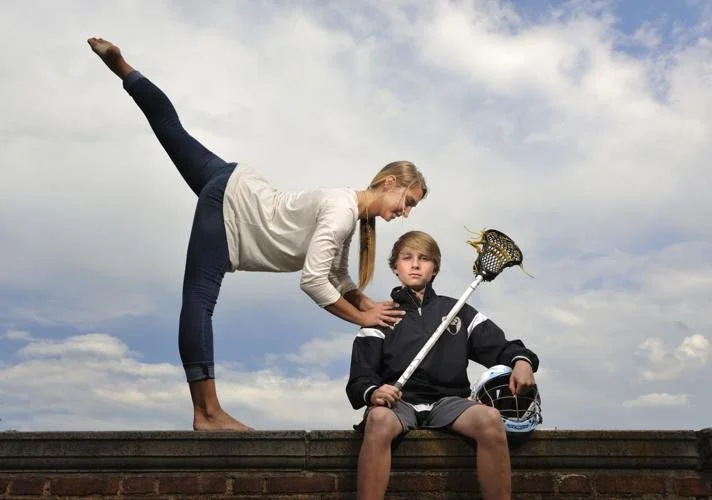
By Brant Wilkerson-New
May 31, 2015
By the age of 13, Riley Shore had put together a combination of agility, athleticism and balance to navigate her way around a 4-inch wide beam like it was a wide-open dance floor.
But in one moment, it disappeared.
For weeks after a fall during gymnastics practice, she showed up at a doctor’s office with one seemingly impossible goal: putting one foot in front of the other to simply walk in a straight line.
“I was in kindergarten again,” she said.
Like 250,000 of her peers in a 2009 Centers for Disease Control report, Shore had suffered a concussion through a sport or recreational activity. From 2001-09, the CDC found that emergency room visits for such injuries rose 57 percent among children under the age of 19.
An accomplished gymnast, reduced to trying to regain the simplest of motor skills. That was life for Riley two years ago after her third and most devastating concussion. For the now 16-year-old junior at Reynolds High School, doctors are still investigating a possible link to the daily migraines she began suffering this spring.
Her first concussion came at either 12 or 13, and there have been two or three more. She and her mother, Gina Shore, settled on the number three. They all seem to run together, they said.
The first was a blur, as they always seem to be, when she missed on a back handspring.
“I didn’t actually know what was going on; I had never experienced that,” Riley said. “I was kind of in a daze with what happened. I forgot; someone had to tell me how I had fallen.
“I think we’re a little confused if I passed out.”
Uninterrupted repercussions
Instead of seeking treatment, she competed in an important meet a week later. She convinced her mother that she was OK until her symptoms worsened and she spent a few days out of school, and two weeks away from gymnastics.
Her second concussion was relatively minor, causing a short interruption in school and her gym routine. It wasn’t until her third — a freak accident — that the gravity of the situation set in.
She was trying to dismount a beam into a foam pit, where there was a wooden plank — a prop that had fallen into the pit from the gym’s “Pirate Day.” The back of her head made contact at full speed as she finished a back flip.
This one was different. She staggered away from the pit, barely able to keep herself upright; her vision shaking.
“My vision was off, and then I did go home and start (vomiting) all over the place,” she said.
Unable to go to school for a week, Riley spent most of her time sitting in a dark room. Something as simple as watching television for a few minutes brought on an unbearable pounding in her head.
“It was very frustrating because I did feel very confined to my room a lot of the day,” she said. “I also couldn’t have the lights on — I was sensitive; it was very frustrating.”
Even after the week spent recovering at home, Riley struggled to return to school, first doing half days to adjust. She struggled to complete her assignments because looking at a screen or paper for too long was just too painful.
“Reading was very hard,” she said. “I had a constant headache all the time, and I couldn’t look at phones or TV.”
Even when the constant headache was gone, they returned at random — often on warm days when Riley was out in the sun for too long.
It took months of therapies — vestibular, physical and even an attempt at meditation — just to get to the point where she was given the OK to return to the sport.
It was at vestibular therapy where she got a glimpse of just how badly she had been affected. Asked to walk or run a straight line, Riley veered off to one side. Asked to balance on one foot while turning her head, she fell — a long way from twirling about on a beam.
“I just kind of laughed at myself, honestly,” she said.
For accomplished and driven athletes and students like Riley, the mental grind can be just as tough as the physical limitations.
“I know her well enough to know that it took a ton of effort to not give into that frustration,” said Ashley Donahue, an athletic trainer who has worked with her. “Well enough to know that’s not where she wanted to be.”
Two years ago, she spent two months away from gymnastics. Doctors told her that if she were to suffer another concussion in the short-term, she would likely have to walk away for good.
In March, serious migraines returned. It can’t be determined at this point if they’re related to the concussions, but Riley has been sidelined since April because she has been unable to get through a full practice.
“I have a daily headache,” she said.
According to a 2011 report published by the National Institutes of Health, as many as 15 percent of people with a history of mild traumatic brain injury suffer symptoms of post-concussion syndrome one year after the injury.
Symptoms range from headaches and irritability to anxiety and depression.
Donahue was impressed with Riley’s approach after the third concussion — something she says is important in helping to educate others around her.
“She knew what she had to do, and she had to be honest,” Donahue said. “To see the change between the first and second one … she knew what had to happen.”
Children can’t make right call
Her experiences played an important role a month ago when younger brother Sully Shore took two shots to the head while playing with Winston-Salem Lacrosse.
Sully, an eighth-grader at Wiley Middle School, ducked his head while running up field and collided with an opponent. After staggering forward, he was knocked over in a scrum.
Gina, who was taking photos in the stands, knew instantly that something was wrong with her son.
“Yeah, and especially when you look at the pictures now,” she said.
The sequence shows the entire progression, from first contact until he ended up on the ground — something of which Sully has little recollection.
Fortunately, there was an EMT and doctor on the sideline that day who, despite Sully’s lobbying, removed him from the game and wouldn’t allow him to return.
Donahue said that removing an injured child from action, and therefore, further possible injury, isn’t always the case, especially at youth sporting events where trainers often aren’t a requirement.
Thanks to the Gfeller-Waller Concussion Awareness Act of 2011, an athletic trainer or first-responder must be present at all high school football games and practices. A recent update to the law states that school districts should aim to have such care available at all high school and middle school athletic events for the purpose of not only responding to an emergency, but examining an athlete and determining whether they should be allowed to return to play.
Youth and recreational leagues have no such requirements, however.
Donahue added that injured children can only do so much to protect themselves.
“As compliant as they want to be, they don’t remember,” Donahue said. “If you don’t have medical staff on the sideline, you’re relying on other minors or somebody from the crowd who may or may not have taken it in as, ‘This is an injury.’”
Given the Shore family’s experience with concussions, Riley checked Sully’s symptoms, and the concussion was treated seriously from the start.
“She was sort of the frontline and tried to talk to him when he had his concussion,” Donahue said. “That’s when we get through to kids, when they start policing themselves, if you will.”
He spent a week away from school, confined by his own body — a “24/7 headache,” pressure in his head and sensitive to light.
A month later, Sully has started to do research on which helmet brands offer better protection, and in one case, tried to stop a teammate from playing through a possible head injury, by asking about his symptoms.
Despite what they’ve been through, Gina said she wouldn’t keep her children from the sports they love, so long as they’re cleared by doctors.
“Not because of concussions, because you can get them from doing anything,” she said. “If (Riley’s) not going to do gymnastics, she’s going to do something else.”
Donahue agreed.
“I wouldn’t have it any other way,” she said. “If she can do it safely, I will be available to them, and if something else were to happen along the way, they will call, and we’ll figure it out.
My job, and what I want to do for kids, is not keep them out of something. It’s to be able to provide a safe environment to be able to do it. I hope she gets back to it.”
For Riley Shore, her head and her heart are still in gymnastics.
“I’ll eventually get back,” she said.
Youth Sports Concussion Series
With NFL head injuries becoming a major media topic the 2010s, I was curious about how high school athletes were being educated and treated for concussions.
Coincidentally, that thread led me down a path of putting together an award-winning series about head injuries in youth sports. As it turned out, there were several local experts thanks to ongoing research at Wake Forest University.
Rather than citing statistics, I chose to pursue angles that humanized the issue. My first piece focused on a family that had already faced significant challenges, as a young gymnast was left relearning basic motor skills before her younger brother suffered his first TBI in a lacrosse match.
The full story is below, and you can find PDF copies of each story in the series:
Head injury common among children in sports
Reynolds’ Andrew Ciaccia gave up lacrosse after severe concussion symptoms
Youth league and high school kids experience 300 to 550 concussion impacts a season