Function vs. fashion: How college basketball players choose their shoes
There are vivid memories of every Carolina-Duke basketball game that I got to cover during my career, but none more clear than the evening of February 20, 2019.
The best and biggest rivalry in sports had somehow gotten even bigger that evening, as President Obama sat courtside to watch two Final Four contenders led by soon-to-be NBA Draft picks.
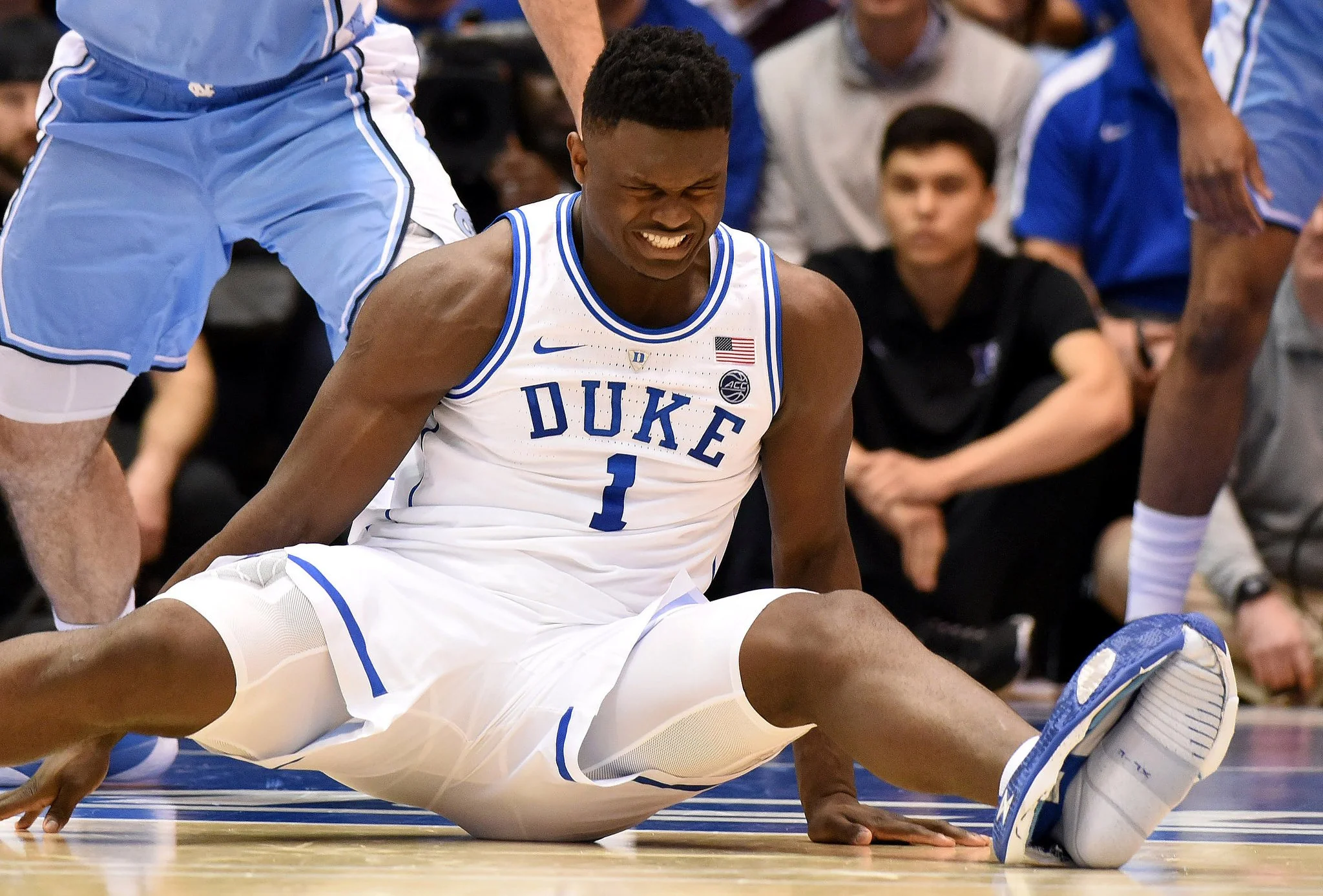
One of the loudest arenas in the world fell silent as Zion Williamson lay on the floor, his left foot poking through what was left of his giant Nike basketball shoe.
Not only was I suddenly thrust into a story that would dominate ESPN for weeks, but I needed to find a way to tell a fresh, compelling story that hadn’t already been rehashed numerous times.
I chose to wait two weeks, until Zion’s return at the ACC Tournament, to pursue a different angle on the story.
If one faulty shoe could potentially alter a phenom’s career, how much thought was being put into what players wear?
I’m proud that this story went on to win First Place for Enterprise Reporting in the 2019 NCPA Editorial and Advertising Awards.
The full story is below, or you can read a PDF version here.
By Brant Wilkerson-New
March 14, 2019
CHARLOTTE — The moment had a chance to alter the course of the college basketball season, and the image of Zion Williamson on the floor at Cameron Indoor Stadium, his left foot poking through his Nike PG 2.5, will forever live in infamy.
In the sport's most-watched game of the season, 4.34 million viewers on ESPN saw it happen and former President Barack Obama watched from the front row, creating a viral moment when he exclaimed, "His shoe broke!" The moment also might serve as a turning point for an oft-overlooked detail, inspiring more players to give more thought to how they choose their shoes, care for them and when to switch to a new pair.
At this week’s ACC Tournament in Charlotte, where Williamson is expected to make his return tonight, several players explained that the decision had often been an afterthought, simply choosing the best-looking shoes that also offer a good fit and level of comfort on the floor.
But just like every tool of the trade, there’s more to a basketball shoe than creating an iconic design and throwing an NBA player’s name on the tongue.
“You should probably choose a shoe that is built for your game,” says Peter Verry, Athletic Editor at Footwear News. “You’re a commodity for these NBA teams; you’re someone they’re going to invest a lot in eventually and you want to keep yourself protected.”
Shoes built for the stars Before there was Air Jordan, Puma created a signature shoe for Walt "Clyde" Frazier, and Magic Johnson and Larry Bird rocked the Converse Weapon.
In the decades since, the sneaker industry has become a world of its own with one-off releases, player editions, collaborations and a billion-dollar resale industry.
Driven by fashion, that side of the business is separate from the world that Adidas, Nike and Under Armour — among others — operate in supplying college and professional basketball players with functional technology in their footwear.
“I can’t tell you how many times I write about new technology in a given month,” Verry says.
It’s obvious in looking at Nike’s news releases featuring its latest innovations with the terms FlyKnit, FlyLeather, FlyEase, Adapt and React all buzzwords used to describe a new type of technology built to give athletes a certain feel they need to perform.
That thought goes into basketball shoes, where a signature shoe for a Kyrie Irving is vastly different than those for LeBron James, James Harden or Stephen Curry.
Verry explained the difference between the Kyrie 5 and the LeBron 16, which are both the latest models of each player’s shoe.
“With the Kyrie, he has a lot of movement, so what Nike did with that shoe is they gave it curved traction, they gave it an outsole that wraps up the side of the shoe to help facilitate the movements,” he says.
For the 6-8, 250-pound James, the value of support is placed over speed. “LeBron needs something a little more sturdy, a little more rugged,” Verry says. “Basically, there are parts that it will lock his foot down more in certain areas, and in certain areas, it will give him more flexibility and a wider range of motion to mirror his game.” The shoes built for James are so unique, Nike created a new material for them, called BattleKnit 2.0, described by its website as “an evolved version of the scalloped knit featured on the LeBron 15. Its structure increases tensile strength (important to contain James’s lateral force on court)…”
According to Dr. Brent Evans of the Triad Foot and Ankle Center, one benefit of basketball shoes is their adaptability vs. soccer or football cleats, which are more focused on locking the foot down.
With basketball shoes, players can be fitted with custom or over-the-counter orthotics or insoles that fit their needs.
'The good-looking shoe'
Despite the attention to detail from sneaker companies, shoes aren’t much more than an afterthought at the college level.
“Whatever we get, the shoes that I like and the shoes that feel the best for me, I’ll rock with them,” N.C. State guard C.J. Bryce says. “Whatever is comfortable for you.”
Bryce says he didn’t get much input from a trainer or equipment manager in the process. State big man Wyatt Walker’s only guidance was being forbidden from wearing low-tops.
Walker says he goes through several pairs per season, ensuring that the shoes he wears for games are well-maintained and structurally sound, while using older shoes in practice.
Bryce rotates between pairs of Adidas, including the BAPE x Adidas Dame 4, but that’s generally more geared toward not wearing out the rare collaboration that is selling for more than $500 online.
Miami big man Ebuka Izundu says he closely watches his shoes, and whenever players suffer injuries, trainers have advice on which to wear.
Wake Forest coach Danny Manning, who was the first NBA player to return to playing after tearing the ACL in both knees, makes a point of talking to his players about the functionality.
“A guy twists his ankle in low-tops,” Manning says. "Comes out a week and a half later in low-tops again, I’m like, ‘Now wait a minute.’”
Recently, Izundu had a pair with which one shoe would frequently come off during games, so he decided to drop those from his rotation.
“Everybody tries to go for the good-looking shoe, but if the good-looking shoe is not as comfortable as the other shoe, I’ll take the other shoes,” he says.
Understanding the wear and tear on a shoe isn’t rocket science.
Whether you’re playing pickup hoops, running a 5K or playing at Duke, pay attention to the seams, ensure the soles aren’t becoming detached and use your own judgment.
“I definitely don’t expect people to get a brand new pair of shoes every game like the pros do,” Evans says, “but once you notice some seams starting to wear out, you’re due for a new pair of shoes.”
While price doesn’t tell the whole story, Evans says, it certainly carries meaning in buying athletic shoes.
“As a general rule, the more expensive the athletic shoe, the better quality it is,” he says. “There’s some validity to that.”
Williamson's choice
Despite all of the technological advances in sneakers recently, plenty of high-level athletes stick with what they know.
Thabo Sefolosha, in the NBA since 2006, has played in the Nike Air Max 90 — a running shoe — because that’s what he’s comfortable in. Forward P.J. Tucker, who started his NBA career in the same season, wore 106 different pairs of shoes in the 2017-18 season, mixing in classics with new releases.
“He’s playing in shoes that are 14 or 15 years old and they’re not built up to the performances standards of today and he’s going on the court because they look great, they get a lot of attention and he likes them,” Verry says. “Is that the smartest move? Probably not.
“The athletes of 10 years ago aren’t as athletic as today. The athletes of today are physical marvels compared to the athletes of today, and 10 years from now, it’ll be the same thing.”
Just like some of Tucker’s shoes, the PG 2.5 was an odd choice for Williamson, whose combination of size, explosiveness and athleticism is perhaps the only rival to James.
“I don’t think he should have been wearing it, but I don’t think it’s the end of the world, either,” Verry says. “If the guy is comfortable in the shoe, he’s comfortable in the shoe and he should wear what makes him feel best on the court.”
The 6-9, 220-pound George plays more of a perimeter game than Williamson, who spends more of his time in the lane.
“Zion is built like a tank and he should be wearing a shoe for someone that is also built like a tank,” Verry says. “Since he has to wear Nike, I’d like to see him in a LeBron 16. LeBron is a very large individual and so is Zion, and that’s something I feel like would be a better fit for him as far as game and size on the court.”
Manning, who was a two-time All-Star before injuries derailed his career, agreed.
“Zion’s built like LeBron — he needs to be wearing LeBrons,” he says. “The low-cut shoes that all the guards wear, the (Kyrie) or the (Kobe Bryant), those didn’t work for me. They’re designed for guys of that size, for the most part.
“You’ve got to forgo fashion sometimes and go with something that’s, in most cases, a little bit bulkier or heavier.”