Marvin Bagley - Enterprise Package
Freshman sensation Marvin Bagley had just finished his junior year of high school in the months before he announced he would be enrolling at Duke.
Naturally, I was wondering the same question that was on everyone’s mind: how exactly did he fit his senior year of high school into one summer?
In the process of finding out, I found myself following a couple of other storylines on how online education was changing the game for talented young athletes and performers, and why people should be beholden to normal timelines.
Turned out, the online education angle became quite relevant much sooner than I expected.
I’m proud of this award-winning story because I allowed myself to go where the facts took me without preconceived notions. Largely, the reaction was that I had captured the full story with key details, presenting the information for readers without choosing a side or editorializing.
Below, you’ll find the full story. Additionally, there are PDF copies of the centerpiece story along with two sidebars that accompanied it in a large print package.
How basketball star Marvin Bagley went from high school junior to Duke freshman
Unique abilities help Marvin Bagley dominate on court, set sights on NBA
Athletes, other students find flexibility with online education
By Brant Wilkerson-New
December 21, 2017
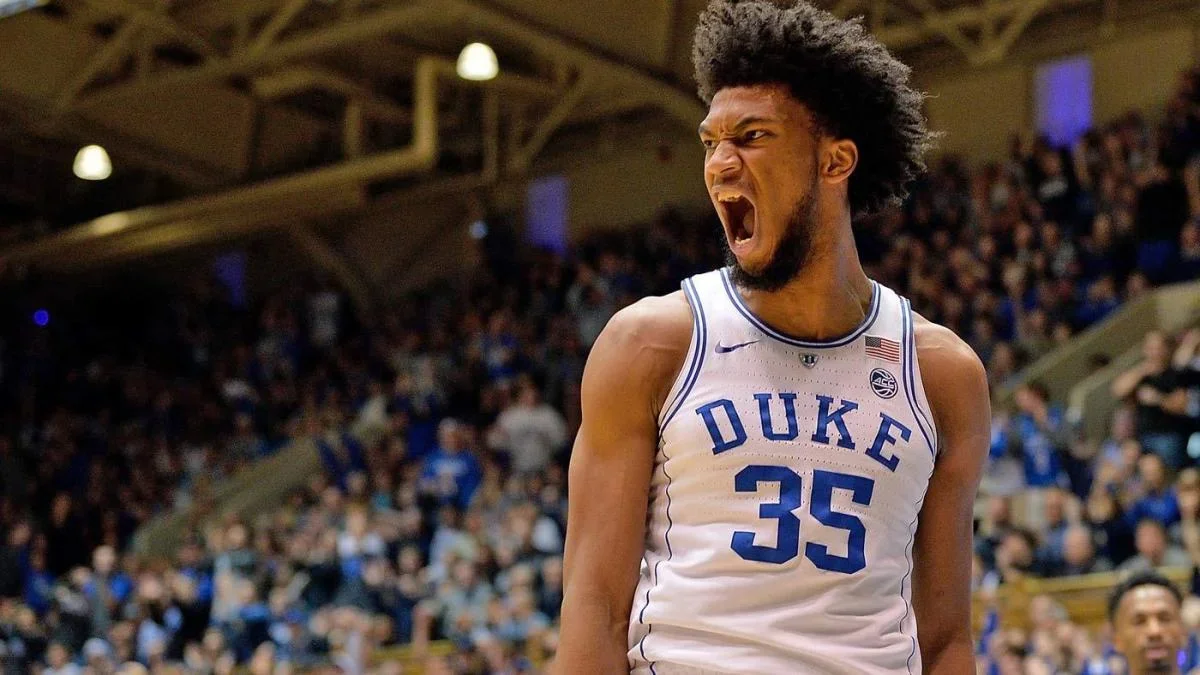
DURHAM — The final steps in Marvin Bagley III’s path from the top recruit in the nation as a high school junior to the best college freshman — and perhaps the best college basketball player in America — all began in June.
Bagley, who attended Sierra Canyon School in suburban Los Angeles, and his family revealed to Duke assistant coach Jeff Capel that a long-discussed plan was in motion to help him reclassify, to complete four years of high school academic work in just more than three and to earn NCAA eligibility. And in turn to join a college program for this season, bypassing a senior year at Sierra Canyon and pushing him one year closer to being able to earn millions as an NBA player.
“We knew it was something that they were thinking about," Capel said. "It wasn’t us saying, ‘You should do this.' It was never that. It was something that they wanted to do.”
When Bagley announced Aug. 14 that he would attend Duke beginning two weeks later, he was well on his way to completing four online courses — Algebra I and Algebra II (in consecutive sessions), Latin and English (which required two sessions) — needed to meet the NCAA's eligibility requirement of having completed 16 core courses.
It wasn’t easy for Bagley, who played basketball with his Phoenix Phamily AAU program and on a Nike circuit. He even made a few appearances in Los Angeles’ famed summer Drew League.
“When I first looked at the classes, I was like, 'Dang, that's going to be a lot,’ ” said Bagley, who turned 18 in March. “But I knew I had to really focus and lock in and not do normal regular teenage stuff that kids do in the summer.
“Pretty much gave up my whole summer for that, to get here and be able to be a part of this team. At the end of the day, I’m glad I did that."
A path that led him to three high schools in two states over three years and resulted in Bagley completing four online courses during a California summer isn't a traditional one for athletes or for students in general. It's a path that his father, Marvin Jr., has turned down a reporter's invitations to discuss.
But his work gained approval from the NCAA's clearinghouse, and that effort could be paying off. Bagley, a 6-11, 235-pound power forward, is averaging 21.3 points and 11.2 rebounds for Duke, which is 11-1 and ranked fourth in the nation. He is cementing his position as one of the top candidates to be drafted No. 1 overall in the NBA after just one season, the latest in a run of "one-and-done" stars to make a brief stop in college on their way to the NBA.
The NBA requires that its players be at least 19, usually meaning they either must spend at least a season in college or play outside of the United States. For Bagley, a potential $5 million salary, an amount slotted in an automatic two-year contract for draft picks, and more money in endorsements could be waiting. Getting to college a year ahead of schedule also helps speed him toward a second, potentially more lucrative NBA contract.
"If I’m a really good player," Duke coach Mike Krzyzewski said, "I’d want to get into that path as soon as possible, and we shouldn’t deny that path.”
How Bagley got himself on that path isn’t without its doubters, including ESPN’s Dick Vitale, usually a positive ambassador for the game.
“I’ll give you another one that blows my mind: the academic geniuses, kids are juniors in June and all of a sudden in August, they graduate, reclassify,” Vitale said during an interview in September on ESPN's "SportsCenter." “I don’t know what goes on behind the scenes — I’m not blaming any school involved — I think the high school, I think the people behind the scenes, wheel and deal. They become Rhodes scholars. It’s a joke; it’s a joke. The term student-athlete is a joke. We talk one-and-done; it’s about time we do something about all of this.”
Others, such as Richard Southall, director of the College Sport Research Institute at the University of South Carolina, see Bagley’s move as a strike back at a system that long has limited athletes' abilities to determine their futures and maximize earnings.
“Yes, in many ways this reflects athletes' wanting to control their commoditized self,” he wrote in an email. “It seems in college sports, this reflects the fact that football and men’s basketball players are economically exploited. Players also recognize that the earlier you can get to a professional career, the sooner you can start monetizing your talents. This is a logical economic decision on the part of the player.”
From Arizona to California
Bagley’s path to Duke, going back to the beginning of his high school career in Arizona, took a few turns.
He burst onto the national scene as he helped lead Corona Del Sol High School in Tempe, Ariz., to a state championship as a freshman, instantly becoming the nation’s top prospect, according to every major recruiting service.
After transferring to Phoenix’s Hillcrest Prep to start the 2015 season, to play in the national spotlight against the nation’s top high school talent, Bagley abruptly left in November of that year. His father, in an interview with the Arizona Republic writer Richard Obert, cited the need to get away from “the negativity following the program.”
The fledgling Hillcrest Prep, a basketball-centric prep school, wasn’t yet eligible for USA Today’s top 25 poll, nor could it qualify for the season-ending Dick’s Sporting Goods Nationals. The prestigious Hoophall Classic in Springfield, Mass., had dropped Hillcrest from a marquee game on ESPN, relegating it to ESPN3.
Around that time, the NCAA also had taken a look into the online school, Starshine Academy, with which Hillcrest was associated academically.
At that time, Hillcrest program director Matt Allen told Obert that Bagley transferred his academic work to Arizona Connections Academy, an accredited online school, to avoid potential academic issues with the NCAA.
Marvin Bagley Jr. then apparently decided to move his family from the Phoenix area to suburban Los Angeles, with Marvin III enrolling at Sierra Canyon School in Chatsworth in January 2016.
California Interscholastic Federation transfer rules kept Bagley off the court for his sophomore season before he was able to compete during his junior year, again cementing his place as the nation's top recruit.
“I had a lot of time to do my work,” Bagley said with a laugh. “I still could practice, but I was still waiting to be cleared. At the same time, I had a lot of time to finish and get ahead on work, so that was a good time.”
Ultimately, he decided to finish his high school education this summer with online classes, which have become more prevalent at every level of education in America. National provider Connections Academy estimates 80 percent growth in online education from the 2009-10 school year through the 2013-14 school year.
Admission and eligibility at Duke
Among the four NCAA core course requirements that Bagley presumably met during the summer were a fourth English class, two of the three required math classes at a level of Algebra I or above and Latin as a foreign language elective.
Nathan Currie, superintendent of N.C. Connections Academy, a public online charter school, said it’s difficult to address a student’s situation without knowing every detail. But he said it’s possible that Bagley was able to complete four courses during the summer.
“They’re working at their own pace,” he said. “They understand they’ve got to really work, but we don’t have those constraints that say you can only work two hours a day in math class. They may work seven hours per day just to get that credit.”
Bagley submitted his transcript and a qualifying test score on either the ACT or SAT to the NCAA at some point within the 10 days prior to Sept. 7, which is the day that Duke announced that the NCAA Eligibility Center had certified his coursework, test scores and amateur status for the upcoming season.
Duke’s admissions department had reviewed Bagley's transcript and academic credentials well before his commitment, well before he began his summer push to graduate.
Cristoph Guttentag, the dean of undergraduate admissions at Duke, said an admissions liaison for each sport reviews any student-athlete before a scholarship offer is finalized. That means Bagley had their attention since June 2015, with consistent communication between the coaching staff and the admissions office.
In the end, every Duke student-athlete must submit a formal application and receive approval from that office.
“All admissions offers are contingent on students' completing their graduation requirements adequately and with no significant change in their academic performance or in their disciplinary standing,” Guttentag said. “So in that sense it’s no different for athletes than for other students.”
The difference, of course, is how quickly the process seemed to work for Bagley.
With two men’s basketball slots available, Duke had room in its freshman class to take on Bagley with no other student-athletes or regular students being affected by his decision to matriculate early.
Per a Duke athletics policy manual available online, the academic credentials of a prospect must be approved tentatively by the admissions office before an official visit. Given that Bagley began his NCAA-defined official visit at Duke on July 20, it would reason that admissions was satisfied with his progress toward a high school diploma at that point.
Through the open door
Naturally, Bagley’s decision to reclassify raised questions about the validity of a rising high school senior suddenly becoming one of the faces of a new college basketball season.
“The door has always been open; kids have been jumping up a grade forever,” said Jerry Meyer, national director of scouting for 247Sports. “People are just tripping because it’s Marvin Bagley and it’s Duke, and not everybody knew it was going to happen, and it didn’t happen on their time schedule.”
The phenomenon isn't particularly new to Duke, with Andre Dawkins and Derryck Thornton having joined the program a year earlier than expected.
Having been in the spotlight since his mixtapes hit YouTube in middle school and now playing for the most polarizing program in college basketball, Bagley has come to accept the scrutiny.
“Man, people are going to say what they want to say about anything that I do,” he said. “At the end of the day, I can’t focus on what people think, because I can’t make everybody happy. I’ve got to do what’s best for me and my family and whatever decisions I make, I don’t listen to what other people have to say.”
ESPN college basketball analyst Jay Bilas, who earned a law degree at Duke after playing for the Blue Devils in the 1980s, sees a bit of a double standard.
“College is available to everybody that applies and can get in,” Bilas said. “When a kid starts college, I don’t see what the big deal is. You have parents now that are making decisions on when to send kids to kindergarten based on wanting them to be a certain age.
“If you had a prodigy musician or mathematician going to college early, isn’t that what ‘Doogie Howser’ was about? So, I don’t see this as being that big of a deal.”
Despite the success of high school-to-pro stars such as Kobe Bryant and LeBron James, the NBA instituted an age limit in its 2005 Collective Bargaining Agreement, meaning players have to spend one year between high school and the NBA Draft either playing elsewhere or training on their own.
While the NBA’s G-League has improved, it’s still not the best option for top players out of high school. The most prominent options for them are to spend a season in college or to play overseas as Brandon Jennings did in 2008 or as LiAngelo and LaMelo Ball are doing now in Lithuania.
That process is different from baseball, hockey, soccer, golf and tennis, in which elite athletes are able to pursue a professional career without an age requirement.
Krzyzewski pointed to a conversation he had with NASCAR driver Dale Earnhardt Jr. on the coach's satellite radio show, talking about Earnhardt's decision to begin his racing career at age 17 as he was finishing high school in Kannapolis.
“Nobody made a big thing about him; he’s a multimillionaire, he followed his dream, and he made a decision that’s what he was going to do,” Krzyzewski said.
There’s plenty to be gained from playing against top-flight competition in the ACC and nationally, but Southall cautioned that this isn’t and shouldn’t be about education — just as it isn’t for any player projected to as a first-round NBA draft pick after his freshman season.
“To make the claim that simply spending one semester in college taking a minimum of six hours is educationally valid and/or educationally equivalent to the educational opportunities afforded other full-time students is laughable,” he wrote. “The infamous ‘one-and-done’ is simply the result of a collective bargaining agreement. It’s not educational.”
Obert, the Arizona Republic reporter, covered Bagley during his freshman season at Corona del Sol and got to know him and his father, who played wide receiver at N.C. A&T from 1993 to '95.
“He was more proud of his son his freshman year for being a 4.0 student that year than what he did on the basketball court,” Obert said. “It didn’t surprise me at all he was able to get his academics done a year ahead of time.
“He was always such a bright kid. Teachers, coaches — everybody loved him — he was like a sponge; he absorbed everything.”
Growing up, Bagley said, his parents placed just as much emphasis on school as they did basketball.
“They’ve always been on me for getting good grades … if I didn’t have straight ‘A’s,’ it was going to be a problem,” Bagley said. “I understand basketball is not going to last forever; one day I’m going to have to stop playing and I’m going to have to go back on something, so being able to have an education is a great thing.”
NBA on hold
The NBA will have to wait for another year, but in the end Bagley will have a chance to recoup the lost year of earnings from being restricted from going directly to the NBA after high school.
“That’s what I have against the one-and-done, and especially since the climate for the really good player, before we get them, has changed dramatically,” Krzyzewski said. “Not illegally — legally — what they can get. You might be looking at what we already have in some sports, a kid represented by an agent before he gets to you. We need to look at all of that stuff.”
Elite high school players are traveling the country, and in some cases the world, on the dime of shoe companies while playing for top AAU programs sponsored by Adidas, Nike and Under Armour. The influence of shoe companies in addition to agents is obvious, as they work to build relationships in the hopes of partnering with players when they turn pro. The underbelly of the game spilled into public this year with indictments of several assistant coaches and shoe executives in a pay-for-play scheme.
Limiting the open marketplace for elite talents is among the reasons that NBA commissioner Adam Silver would like to see the age limit dropped.
“It’s clearly not working for the college game,” he said on ESPN Radio's "Mike and Mike" in October.
Southall had an even more radical approach, suggesting that college basketball follow a similar model to the NHL, which allows drafted players to attend college while the franchise holds onto their rights.
“The sanctimonious view that denying an athlete access to the market somehow makes him/her a better person is laughable,” he said. “It would really not change things in any fundamental way for college athletes to be paid. Why not let a Marvin Bagley sign an NBA contract, get paid an honest wage and play for one or two years for a college team?”
That way, a player would have a chance to play in a strong developmental system without having to give up money and, in the process, make strides toward a degree, should he choose to go that route.
“Let him play in college until he is ready to play in the NBA,” Southall said. “If he wants to take some classes, let him. Let him choose what classes. He can also negotiate an arrangement that he can come back to school after his NBA career is over and take classes toward a meaningful degree. What is immoral about such an arrangement?”