Signing off: Raycom airing its final ACC Tournament
Long before every team had every game on every channel, there was trusty ol’ Raycom, delivering a significant portion of the ACC basketball games you’d have the chance to watch every week.
As the business of college athletics grew during the 2010s, Raycom was ultimately squeezed out of the broadcasting world, as conferences negotiated megadeals with ESPN to fill their inventory of linear and steaming programming. For many fans, this was the most tangible effect of the wave of change that had just begun. Raycom pioneered the regional broadcasting format, and in many ways, was responsible for the ACC becoming the nation’s premier college basketball league.
On the eve of its final ACC Tournament, I dove into the history and impact that Raycom made in throwing a few college basketball games on television out of Greensboro and Charlotte, and what’s next in the new world of digital media.
The full story is below, and you can find a PDF version of the centerpiece here, along with a sidebar from the package here.
By Brant Wilkerson-New
March 11, 2019
CHAPEL HILL — First, C.D. Chesley captured our imaginations in 1957 by sending ACC basketball into living rooms along Tobacco Road for the first time, then we spent Saturday afternoons sailing with the Pilot, Thacker and Packer as the league established itself as the best in the nation.
From there, an upstart group from Charlotte took the reins, giving ACC basketball an unprecedented primetime platform for the first time and helping to begin what would become a revolution in the high-stakes world of college sports television.
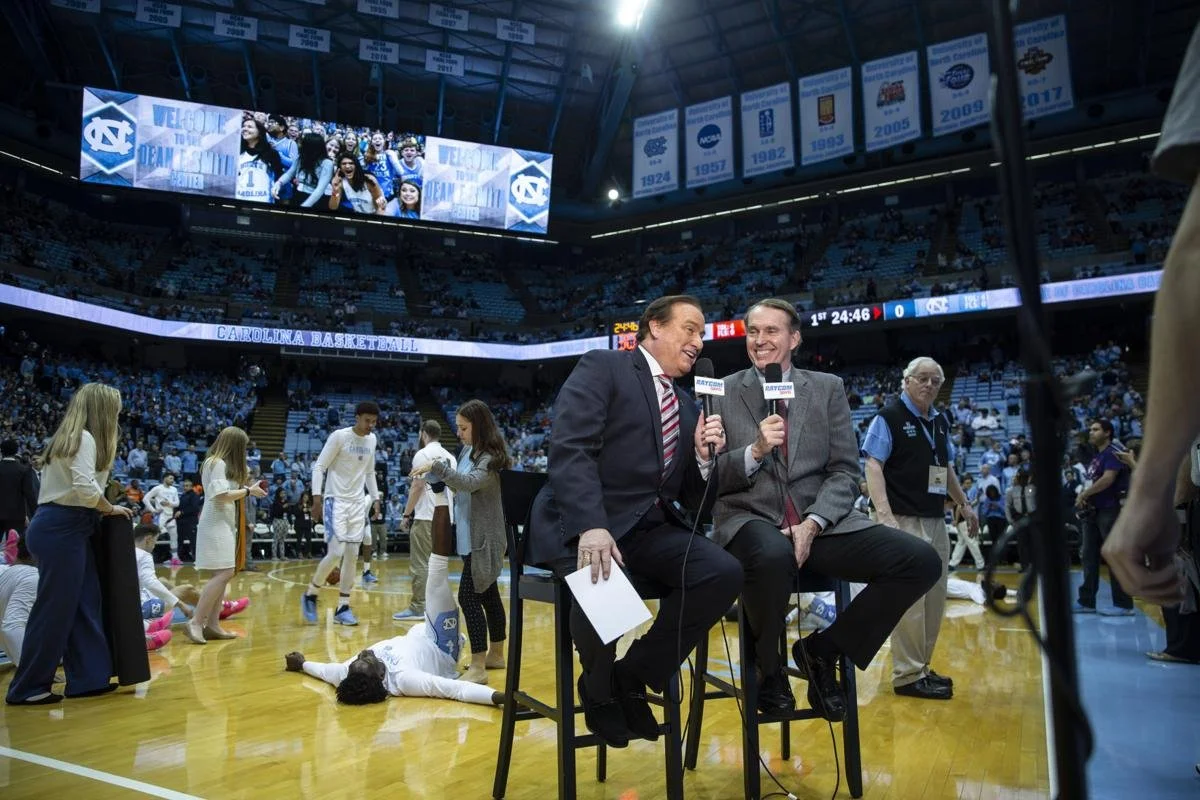
For the past 37 years, Raycom Sports has become as much a part of the fabric of North Carolina’s culture as Cheerwine and "The Andy Griffith Show," the familiar voices of Dan Bonner and Tim Brando offering a warm soundtrack on a cold winter evening.
This week, schoolteachers across the Old North State will wheel televisions into their classrooms for the last time to watch a Raycom broadcast of the ACC Tournament as the conference prepares to launch the ACC Network in partnership with ESPN, ending 37 years of syndication on local television networks throughout the league’s geographic region.
“For a lot of long-time ACC fans, that connection between Raycom and the ACC is almost ingrained,” ACC commissioner John Swofford said. “The length of that relationship and partnership is sort of unheard of, really, in sports television.
"It’s a tremendous credit to the partnership over the years — and it truly has been a partnership — and a tribute to that company and its growth, its ability to adjust to the times."
A game-changer
What became a 37-year partnership was anything but certain early as Raycom, a fledgling production company, won the rights to the Great Alaska Shootout and produced non-conference games for some ACC programs.
Raycom sought the league’s conference package for the 1980-81 season but came up short as the league awarded it to Washington-based Metro Sports. The next time the contract came up for bidding, Raycom joined forces with Jefferson-Pilot Sports, which was on better financial footing thanks to its backing from Greensboro's Jefferson-Pilot Insurance.
Together, Raycom and Jefferson-Pilot were awarded a three-year, $18 million contract for rights to the league’s basketball broadcasts starting in the 1982-83 season in one of the first major media deals in college sports television, easily pricing out the likes of Chesley, who had paid $600,000 for the league’s rights in the 1979-80 season.
Officials around the ACC were shocked with how the bidding war unfolded.
"We suspected that it would be significant, but it was more significant than we expected," Swofford said.
Not only was it significant then, but even today, Swofford views the first Raycom deal as a game-changer in the history of televised college sports.
"I certainly think it was one of those launch points, and from a basketball perspective, it definitely was," he said.
In the early days of ACC basketball, one Saturday afternoon broadcast was the standard before Chesley added double- and triple-headers. Raycom had bigger ambitions; ambitions that were considered crazy at the time, as CEO Ken Haines and his team believed they could make college basketball primetime programming during the week and persuade stations to pre-empt popular network shows.
Chesley laid the groundwork, creating a region hungry for hoops.
"It created a generation of extraordinary basketball fans," Swofford said. "We were lucky to have really good teams that people wanted to see and I don’t think basketball fans then or now, anywhere in the country, were more passionate than ACC fans. Television in those early years really fed that, developed it and nourished it, and that just continued to grow that when we did put it out there, we had multiple bidders. The appetite for ACC basketball on television had been laid."
With the table set, Raycom was ready to roll out a buffet.
“Our belief was that the market could accommodate more games, fans wanted more games,” Haines said. “It was a gamble. We felt the market was there, didn’t know for sure, but felt the market was there.”
One gamble would be met with another as Raycom’s decision-makers knew that the only way they could afford to continue growing their empire was to do something unheard of in television in which they’d retain and be responsible for all commercial inventory throughout their broadcasts.
Typically, the partner stations that air syndicated broadcasts would keep half the commercials to sell for themselves throughout games. Instead, Raycom bought out almost all of the inventory for its broadcasts and even paid additional fees to stations outside of the ACC region to acquire the advertising time.
“That was a dramatic departure and we gambled that the product was so popular that the stations would agree to the new deal,” Haines said. “We would generate enough additional revenue to make up for the compensation we had to pay in some markets.”
The ACC’s early sponsors made it all possible, as Anheuser-Busch, Holly Farms, Hardee’s, Food Lion, Pepsi and Chrysler — among others — took a chance and helped make Raycom’s financial plans viable. There were challenges because of laws on interstate banking at the time, as multiple feeds had to be used to accommodate regional commercials, with one feed sending out advertising for Belk stores and North Carolina National Bank while the other used ads for Leggett Stores and Central Fidelity Bank.
'A golden era'
ACC basketball entered a whole new world on Dec. 8, 1982, when Raycom aired its first conference matchup as Virginia visited Duke in a broadcast that nearly didn’t happen at all.
Haines, who was en route to Greensboro to oversee the production of the game from a truck in a parking lot outside WFMY, heard on the radio about a bomb threat at the Washington Monument.
Right up until the 9 p.m. tipoff that night, there were doubts Raycom would go on the air as stations stuck with network news coverage rather than releasing the AT&T long lines for the broadcast.
“It’s amazing to me — to this day — how close we came to not being successful in our very first telecast with the ACC and not being able to get the game on the air,” Haines said.
Fortunately for both the ACC and Raycom, the first-night hiccups were an aberration in what would become the most successful syndication partnership in college sports with every bit of commercial inventory sold out that for the first telecast.
Duke coach Mike Krzyzewski was in his third season when Raycom took over, giving the young coach a new level of exposure as the Blue Devils began building their dynasty.
“Huge,” Krzyzewski said of Raycom’s influence. “Nobody in the country had primetime TV. It went 8 o’clock, right head-to-head with the other competition. To give our sport that exposure at that time has led to the exposure we have today and kept us ahead. I still think the ACC is the best conference with our tournament, the TV package. They’ve been a pioneer in how the game has developed into what it’s developed right now and, certainly, Raycom has been an integral part of that.”
Several ACC coaches had established a recruiting pipeline in New York City, but the league’s new television exposure made it the best and biggest show on the East Coast, evidenced by six players from the D.C. area on Krzyzewski’s first Final Four team in 1986.
Jim Sumner, a longtime local sportswriter and 1972 Duke graduate, has followed the league since growing up in Robeson County.
“The coaches from back in that era … they used that as recruiting, particularly since the ACC schools recruited the East Coast,” he said. “It was just different; it was a big deal being on TV. It’s not a big deal now — it’s Tuesday.”
It didn’t hurt that Raycom’s expanded package hit during an era that featured national championship teams for North Carolina and N.C. State along with stars such as Ralph Sampson and Len Bias, along with Bobby Cremins building a strong program at Georgia Tech.
“We both helped each other,” Raycom CEO Jimmy Rayburn said. “Obviously, they were plenty good without us, but it was a golden era. It was the era of (Michael) Jordan and Bias and a lot of great players.”
'The last man standing'
Now 37 year later, the idea of not being able to watch an ACC basketball game — really, most any conference’s basketball games — is absurd.
If it’s not on one of ESPN’s offerings or a conference’s own network, games are on any number of regional networks: NBC Sports, CBS Sports, Fox Sports' regional cable systems or one of the major networks.
Somehow, Raycom has remained, switching positions with ESPN in 2011 and licensing broadcasts from the sports giant. Over the years, Raycom could feel the tide turning in sports television based on carriage fees that ESPN was getting from cable companies and began to diversify its business, building its digital operation, getting into the event business and upgrading its two production trucks.
“We’re the last man standing in syndication,” Rayburn said. “For a long period of time, we were the ones making enough money to be the last one standing, to be able pay the increase rights fees that the ACC demanded.”
As media rights deals have exploded, with SEC and Big Ten schools raking in more than $40 million apiece annually, Raycom has maintained its niche in the ACC for several reasons.
One of those reasons being that the ACC's television revenue remained ahead of its football dollars until 1998 or 1999, Swofford estimated. Ultimately, football changed the landscape of college sports on television and syndication was no longer viable in keeping up with peer conferences.
“We knew it was going to be difficult,” Rayburn said. “Because of the relationship, because of our relationship with the conference, we were able to get these last years.”
Raycom has touched far more than ACC basketball fans as the company became respected nationally not only for its product, but how it treated those it worked with, whether that be young talent or industry partners.
John Wildhack, now the athletics director at Syracuse, arrived at ESPN in 1980 and spent 30 years with the network, working closely with Raycom over that period.
As ESPN looked to make its mark, the early rounds of the NCAA Tournament, Big East basketball and sublicensing games from Raycom helped it get established.
“The ACC, at that time as it is today, was the pre-eminent conference,” Wildhack said. “At that time, for ESPN to have North Carolina games (and Virginia, N.C. State, Duke) really helped ESPN generate momentum from a business perspective and also from a ratings perspective and a credibility perspective with fans.”
Wildhack played the role of licenser and licensee in his time working with Raycom, and through it all, always enjoyed doing business with the Rays, Haines and Rayburn.
“Kenny is one of my all-time favorite people in the industry and we did a lot of work together, we did a lot of deals together,” he said. “We would bicker appropriately back and forth with one another, but we developed a tremendous mutual respect and friendship.”
Launching careers
It’s the little things that stand out for longtime Raycom commentators Dan Bonner and Tim Brando.
Bonner pointed out the pregame meal Raycom served before Carolina’s win over Syracuse on Feb. 26 — something that is no longer industry-standard — as executives sat down for barbecue with folks who work behind the scenes pulling cable.
Brando, a fixture on ESPN, CBS and Fox broadcasts, got his start with Raycom in 1985 and has maintained that relationship for one simple reason.
“If the relationship is that honest or that good, you just can’t wait to do another game for them,” he said. “I’ve always enjoyed the notion of just having fun or getting to call the game. Now, in network TV, you never know if you’re going to get to control your own destiny. Just like a pilot going up, you’d like to control that plane.”
Working with Raycom certainly gave people a chance to take off, as it also helped launched the careers of sportscasters such as Jay Bilas, Brad Nessler and Mike Patrick. Of course, no discussion of the company's talent would be complete without mentioning the legendary Billy Packer, who got his start with Chesley and polarized audiences across NBC and CBS. One of the benefits of working with Raycom was that talent was free to appear elsewhere.
“Obviously they have an eye for talent, I think they have the ability to help that talent develop,” Brando said. “They hire you and they stay out of your way. They hire you to do a job and expect you to do the job and they give you a lot of support.”
As a young producer at ESPN, Wildhack kept his eye on who had the call at Raycom.
“There’s a number of people who are talent at ESPN that frankly, we discovered through Raycom,” he said.
A perfect arrangement
Shortly after the final buzzer of the ACC championship game on Saturday night, Raycom’s final broadcast of ACC basketball will sign off, another casualty in the billion-dollar business of college athletics.
At is peak, Raycom was broadcasting 500 games per year through deals with the ACC, Big East, Metro, Pac-10, SEC and Southwest conferences. Now, 14 games remain starting with a noon tipoff Tuesday at the Spectrum Center in Charlotte.
The new ESPN contract will push the ACC to another level, but something will be lost along the way in the down-home feel of Raycom broadcasts that can reach the televisions in North Carolina that cable just cannot.
“When it’s taken off over-the-air, commercial television, there will be a significant drop in terms of numbers of people watching ACC sports,” Brando said. “Now, that doesn’t matter as much to the conferences as it once did because they’re not concerned about ratings; they’re concerned about how much they’re making. As long as major cable companies are going to pay enormous rights fees…they’re going to willingly accept that money and not worry that ESPN doesn’t have as many viewers in Raleigh as WRAL does for the Duke-North Carolina game.”
Some sadness will accompany the end of an era, but with it comes pride — not only in what Raycom built, going from an ambitious outsider to industry giant — but in helping the ACC become one of the nation’s premier conferences.
“Gene Corrigan and Tom Butters and John Swofford said it, that the ACC probably wouldn’t have been able to grow to the degree that it did and the extent that it did without a very strong television package that Raycom provided,” Haines said. “Certainly, Raycom, in choosing the ACC as our bedrock conference, was able to grow because of the popularity of ACC basketball. It was a hand-in-hand, very good deal. What was good for the ACC was good for Raycom and what was good for Raycom was good for the ACC, and that’s the perfect type of business arrangement.
“It’ll be very strange, but it’ll be somewhat gratifying to know that all of this might not have been possible without Raycom."
Wildhack, who has been on both sides, certainly agrees.
“The exposure that Raycom delivered for ACC schools at that time was really groundbreaking — absolutely groundbreaking,” he said. “I think, instrumental in helping the conference build the brand and the reputation it enjoys today.”